
ดาวเคราะห์หกดวงจะปรากฏอยู่เหนือขอบฟ้าหลังพระอาทิตย์ตกดินประมาณวันที่ 28 กุมภาพันธ์ 2026 เริ่มสังเกต 30-60 นาทีหลังพระอาทิตย์ตกดิน บริเวณขอบฟ้าด้านทิศตะวันตกต่ำ ดาวเคราะห์สี่ในหกดวงจะสามารถมองเห็นได้ด้วยตาเปล่า!
Source: 6-Planet Alignment on Feb 28, 2026: Best Time & Where to Look
25 กุมภาพันธ์ 2569
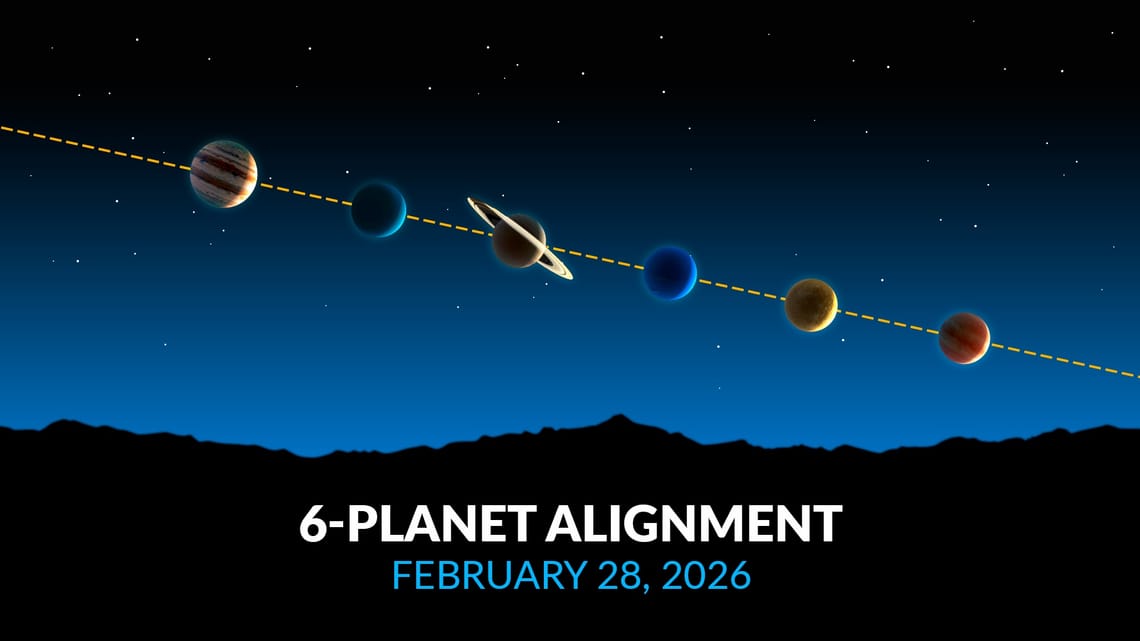
ประมาณวันที่ 28 กุมภาพันธ์ 2026 จะมีดาวเคราะห์ 6 ดวงปรากฏอยู่เหนือขอบฟ้าหลังพระอาทิตย์ตกดิน พวกมันไม่ได้อยู่รวมกันเป็นกลุ่ม แต่กระจายตัวอยู่ทั่วท้องฟ้า เริ่มสังเกตประมาณ 30-60 นาทีหลังพระอาทิตย์ตกดินตามเวลาท้องถิ่น: ดวงแรกอยู่ต่ำทางทิศตะวันตก (ดาวพุธ ดาวศุกร์ ดาวเสาร์) จากนั้นดวงที่สองอยู่สูงทางทิศตะวันออกเฉียงใต้/ตะวันออก (ดาวพฤหัสบดี) ส่วนดาวยูเรนัสและดาวเนปจูนนั้นสว่างน้อยมาก ต้องใช้กล้องโทรทรรศน์ช่วยในการสังเกต ใช้ แอป Star Walk 2 เพื่อรับคำแนะนำที่แม่นยำแบบเรียลไทม์
สารบัญ
- การเรียงตัวของดาวเคราะห์ในวันที่ 28 กุมภาพันธ์ 2026: รายละเอียดสำคัญ
- ตรวจสอบความเป็นจริง: สิ่งที่คุณจะได้เห็นจริง ๆ (และ “ความสำเร็จ” หน้าตาเป็นอย่างไร)
- จะเกิดอะไรขึ้นในช่วงที่ดาวเคราะห์เรียงตัวกันในวันที่ 28 กุมภาพันธ์?
- ช่วงเวลาใดจึงจะเห็นดาวเคราะห์ทั้งหกดวงเรียงตัวกัน?
-
ในช่วงที่ดาวเคราะห์เรียงตัวกัน จะสามารถมองเห็นดาวเคราะห์ดวงใดได้บ้าง?
- ดาวพุธ: ปรากฏตัวสั้นๆ ในช่วงเย็น
- ดาวศุกร์: หลักนำทางอันสว่างไสว
- ดาวเสาร์: มั่นคงและงดงามดุจทองคำ
- ดาวเนปจูน: เพื่อนบ้านที่แสนจะลึกลับของดาวเสาร์
- ดาวยูเรนัส: สูงขึ้นไปบนท้องฟ้า แต่กลับมองเห็นได้ยากขึ้น
- ดาวพฤหัสบดี: ยักษ์แสงเจิดจรัสแห่งทิศตะวันออกเฉียงใต้
- การจัดเรียงตัวของดวงดาวเปลี่ยนแปลงอย่างไรในระหว่างคืน
- วิธีการค้นหาดาวเคราะห์ทั้งหกดวงได้อย่างง่ายดาย
- ควรดูที่ไหนเพื่อสังเกตการเรียงตัวของดาวเคราะห์ในวันที่ 28 กุมภาพันธ์ 2026?
- เคล็ดลับง่ายๆ สำหรับการชมปรากฏการณ์ “ขบวนพาเหรด” ดาวเคราะห์ในเดือนกุมภาพันธ์ 2026
-
คำถามที่พบบ่อย: การเรียงตัวของดาวเคราะห์ในวันที่ 28 กุมภาพันธ์ 2026
- การเรียงตัวของดาวเคราะห์คืออะไร?
- ทำไมเดือนกุมภาพันธ์ 2026 ถึงกำลังเป็นที่นิยม?
- ดาวเคราะห์ดวงใดบ้างที่จะเรียงตัวกันในวันที่ 28 กุมภาพันธ์ 2026?
- ดาวเคราะห์ทั้งหกดวงจะสามารถมองเห็นได้ด้วยตาเปล่าหรือไม่?
- เวลาไหนเหมาะสมที่สุดสำหรับการตรวจสอบการจัดเรียงแนวแกน?
- ช่วงเวลาใดเหมาะสมที่สุดในการชมการเรียงตัวของดาวในสหรัฐอเมริกา?
- ช่วงเวลาใดเหมาะสมที่สุดในการชมการเรียงตัวของดวงอาทิตย์ในสหราชอาณาจักร (อังกฤษ)?
- ฉันควรเงยหน้ามองไปทางไหนบนท้องฟ้า?
- เหตุใดจึงยากที่จะมองเห็นดาวพุธ (และบางครั้งดาวเสาร์)?
- ฉันจำเป็นต้องใช้กล้องโทรทรรศน์เพื่อมองเห็นดาวยูเรนัสและดาวเนปจูนหรือไม่?
- การเรียงตัวแบบนี้หายากไหม?
- การเรียงตัวของดาวเคราะห์หกดวงในวันที่ 28 กุมภาพันธ์ 2026: ข้อสรุป
การเรียงตัวของดาวเคราะห์ในวันที่ 28 กุมภาพันธ์ 2026: รายละเอียดสำคัญ
- วันที่: 28 กุมภาพันธ์ 2569
- ช่วงเวลาที่ดีที่สุด: ประมาณ 30 นาทีหลังพระอาทิตย์ตกดินในท้องถิ่น
- ควรดูจากจุดไหน: จากทิศตะวันตกต่ำ (ดาวพุธ/ดาวศุกร์/ดาวเสาร์) ไปจนถึงทิศตะวันออกสูง (ดาวพฤหัสบดี)
- มองเห็นได้ด้วยตาเปล่า: ดาวพุธ ดาวศุกร์ ดาวเสาร์ ดาวพฤหัสบดี
- ต้องใช้กล้องส่องทางไกลหรือกล้องโทรทรรศน์: ดาวเนปจูน
หากคุณไม่คุ้นเคยกับคำว่า “การเรียงตัวของดาวเคราะห์” หรือ “ขบวนดาวเคราะห์” โปรดอ่านคู่มือของเรา: ขบวนดาวเคราะห์คืออะไร? คำอธิบายเกี่ยวกับการเรียงตัวของดาวเคราะห์
ระยะเวลารับชมสั้น (สหรัฐอเมริกาและสหราชอาณาจักร)
ช่วงเวลาที่ดีที่สุดเริ่มต้นประมาณ 30 นาทีหลังจากพระอาทิตย์ตกดินตามเวลาท้องถิ่น นี่คือเวลาโดยประมาณในการ “เริ่มมองหา” สำหรับเมืองใหญ่บางแห่ง:
| เมือง | วันเดทที่ดีที่สุด | พระอาทิตย์ตกในท้องถิ่น | เริ่มค้นหา (~+30 นาที) |
|---|---|---|---|
| นิวยอร์ก | 28 ก.พ. | 17:45 น. | 18:15 น. |
| วอชิงตัน ดี.ซี. | 28 ก.พ. | 17:59 น. | 18:29 น. |
| ชิคาโก | 28 ก.พ. | 17:39 น. | 18:09 น. |
| ดัลลัส | 28 ก.พ. | 18:23 น. | 18:53 น. |
| เดนเวอร์ | 28 ก.พ. | 17:50 น. | 18:20 น. |
| ฟีนิกซ์ | 28 ก.พ. | 18:24 น. | 18:54 น. |
| ลอสแอนเจลิส | 28 ก.พ. | 17:48 น. | 18:18 น. |
| ซีแอตเติล | 28 ก.พ. | 17:52 น. | 18:22 น. |
| ลอนดอน (อังกฤษ) | 1 มีนาคม | 17:40 น. | 18:10 น. |
| แมนเชสเตอร์ (อังกฤษ) | 1 มีนาคม | 17:46 น. | 18:16 น. |
เวลาที่ระบุเป็นเวลาโดยประมาณ สำหรับตำแหน่งและขอบฟ้าที่แน่นอน โปรดใช้ แอปดูดาว Star Walk 2
ตรวจสอบความเป็นจริง: สิ่งที่คุณจะได้เห็นจริง ๆ (และ “ความสำเร็จ” หน้าตาเป็นอย่างไร)
ใช่แล้ว ในวันที่ 28 กุมภาพันธ์ จะมีดาวเคราะห์หกดวงปรากฏอยู่เหนือขอบฟ้า แต่การมองเห็นดาวเคราะห์ทั้งหกดวงนั้นเป็นความท้าทายอีกแบบหนึ่ง
คนส่วนใหญ่จะมองเห็นดาวพฤหัสบดีและดาวศุกร์ได้ง่ายๆ ดาวเสาร์ก็มองเห็นได้ แต่ในแสงสนธยาที่สว่างอาจดูจางๆ ดาวพุธเป็นดาวเคราะห์ที่ “ถ้าไม่สังเกตดีๆ จะมองไม่เห็น” เพราะมันอยู่ต่ำมากและจะลับขอบฟ้าไปอย่างรวดเร็วหลังพระอาทิตย์ตก ดาวเนปจูนมักต้องใช้กล้องสองตา และดาวเนปจูนโดยทั่วไปต้องใช้กล้องโทรทรรศน์ในการมองเห็น
ดังนั้นอย่าตัดสินการฝึกซ้อมของคุณด้วยเกณฑ์ “ทำครบหกครั้งหรือไม่ก็ไม่ทำเลย” ผลลัพธ์ที่ดีเยี่ยมคือ:
- ระดับ 1 (ง่าย): ดาวพฤหัสบดี + ดาวศุกร์
- ระดับ 2 (ดี): เพิ่มดาวเสาร์และ/หรือดาวพุธ
- ระดับ 3 (โหมดท้าทาย): ยูเรนัส (กล้องส่องทางไกล) + เนปจูน (กล้องโทรทรรศน์, ท้องฟ้ามืด)
จะเกิดอะไรขึ้นในช่วงที่ดาวเคราะห์เรียงตัวกันในวันที่ 28 กุมภาพันธ์?
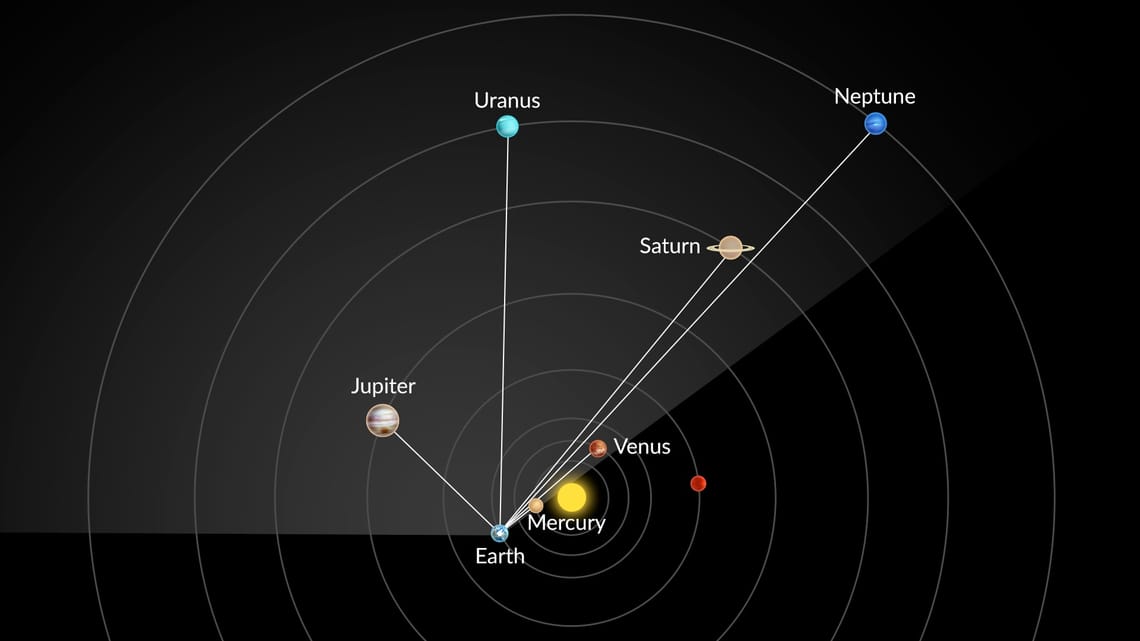
ในวันที่ 28 กุมภาพันธ์ 2026 ดาวเคราะห์หกดวงจะปรากฏอยู่เหนือขอบฟ้าในค่ำคืนเดียวกัน ซึ่งเป็นเหตุผลที่วันดังกล่าวถูกเรียกกันอย่างแพร่หลายว่า “ขบวนพาเหรดดาวเคราะห์”
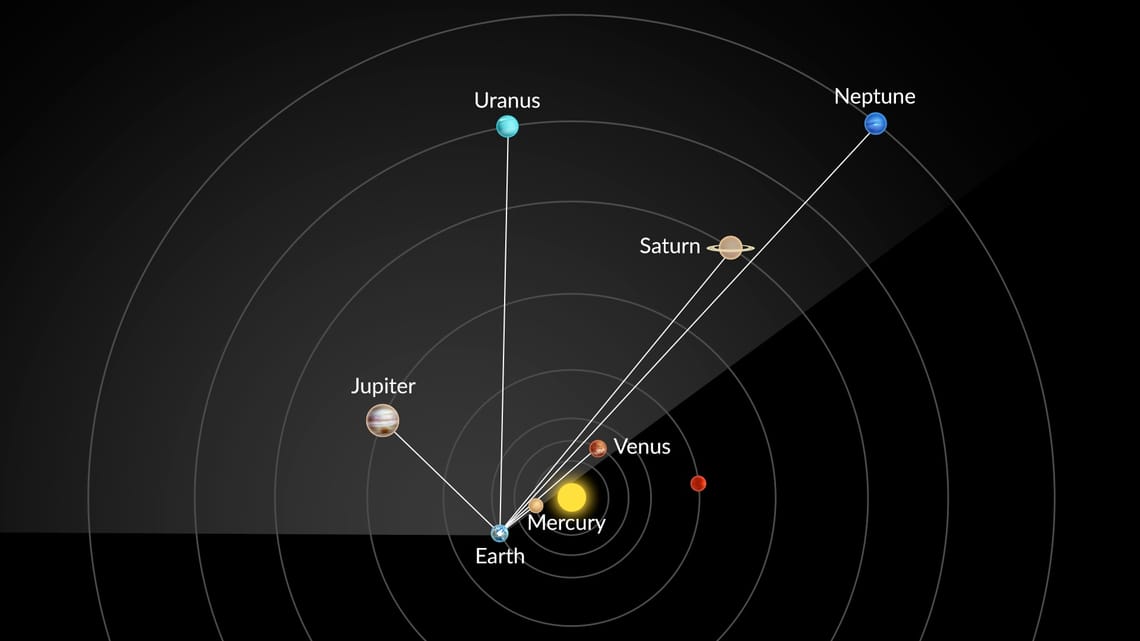
สิ่งที่คุณจะสังเกตเห็นบนท้องฟ้าจริงๆ คือกลุ่มดาวเคราะห์ที่เรียงตัวเป็นรูปโค้งตามแนวสุริยวิถี (เป็นผลจากแนวสายตา ไม่ใช่เส้นตรงที่สมบูรณ์แบบในอวกาศ) โดยมีดาวเคราะห์สว่างสี่ดวงเป็นจุดเด่น และดาวเคราะห์จางอีกสองดวงเป็นความท้าทายสำหรับกล้องสองตาหรือกล้องโทรทรรศน์
©Vito Technology, Inc.
นาซาได้กำหนดให้วันนี้เป็น “ขบวนพาเหรดดาวเคราะห์” และเหตุผลหลักที่ทำให้วันนี้พิเศษก็คือ เราสามารถมองเห็นดาวเคราะห์สว่างหลายดวงพร้อมกันได้โดยไม่ต้องใช้กล้องโทรทรรศน์
ขบวนพาเหรดนี้จะประกอบด้วย:
- ปรอท
- ดาวศุกร์
- ดาวเสาร์
- ดาวพฤหัสบดี
- ยูเรนัส
- ดาวเนปจูน
ปรากฏการณ์ทางดาราศาสตร์เช่นนี้ค่อนข้างหายาก โดยเฉพาะอย่างยิ่งเมื่อ สามารถมองเห็น ดาวเคราะห์สว่างสี่ดวง พร้อมกันได้ โดยไม่ต้องใช้อุปกรณ์ช่วยดูดาวใดๆสิ่งที่ทำให้ “ขบวนดาวเคราะห์” นี้พิเศษยิ่งขึ้นไปอีกก็คือ การที่สามารถมองเห็นได้ในตอนเย็นซึ่งสะดวกกว่าสำหรับผู้สังเกตการณ์ส่วนใหญ่มากกว่าการเรียงตัวกันในตอนเช้าตรู่ หากคุณต้องการคำอธิบายทั่วไปเกี่ยวกับสิ่งที่นับว่าเป็น “ขบวนดาวเคราะห์” (และการเรียงตัวกันอื่นๆ ที่กำลังจะเกิดขึ้น) โปรดอ่าน คู่มือขบวนดาวเคราะห์ ของเรา
ช่วงเวลาใดจึงจะเห็นดาวเคราะห์ทั้งหกดวงเรียงตัวกัน?
นี่เป็นเหตุการณ์ที่เกิดขึ้นในช่วงปลายเดือนกุมภาพันธ์/ต้นเดือนมีนาคม ไม่ใช่ช่วงเวลาสั้นๆ เพียง 5 นาที: แต่ละสถานที่จะมี “รายชื่อศิลปินที่แน่นที่สุด” ในช่วงเย็นที่แตกต่างกันเล็กน้อย
- วันสำคัญ: 28 กุมภาพันธ์ 2569
- ช่วงเวลาที่ดีที่สุด: ชั่วโมงแรกหลังพระอาทิตย์ตกดิน (ดาวพุธมีความอ่อนไหวต่อเวลา)
- ช่วงเวลาที่สามารถมองเห็นได้: ปลายเดือนกุมภาพันธ์ถึงต้นเดือนมีนาคม (แตกต่างกันไปตามสถานที่)
วันที่ 28 กุมภาพันธ์เป็น วันเฉลี่ย ซึ่งเป็นช่วงเวลาที่ดาวเคราะห์ปรากฏอยู่ใกล้กันมากที่สุดในหลายๆ สถานที่ทั่วโลก ทั้งนี้ขึ้นอยู่กับว่าคุณอาศัยอยู่ที่ไหน วันที่เหมาะสมที่สุดในการชมอาจตรง กับวันก่อนหรือหลังวันนั้นไม่กี่วัน
ช่วงเวลาที่ดีที่สุดในการชมขบวนพาเหรดดาวเคราะห์ตามสถานที่ต่างๆ
ต่อไปนี้เป็นตัวอย่างวันที่ดาวเคราะห์ต่างๆ มารวมตัวกันในบริเวณที่เล็กที่สุดของท้องฟ้า:
- เซาเปาโล: 25 กุมภาพันธ์
- เอเธนส์: 28 กุมภาพันธ์
- นิวยอร์ก: 28 กุมภาพันธ์
- เม็กซิโกซิตี้: 28 กุมภาพันธ์
- โตเกียว: 28 กุมภาพันธ์
- ปักกิ่ง: 1 มีนาคม
- เบอร์ลิน: 1 มีนาคม
- ลอนดอน: 1 มีนาคม
- มุมไบ: 1 มีนาคม
- เรคยาวิก: 2 มีนาคม
เพื่อเลือกวันและเวลาที่เหมาะสมที่สุดในการชมดาวสำหรับตำแหน่งของคุณ ให้ใช้ ฟีเจอร์ Planet Walk ใน แอป Star Walk 2
ในช่วงที่ดาวเคราะห์เรียงตัวกัน จะสามารถมองเห็นดาวเคราะห์ดวงใดได้บ้าง?
©Vito Technology, Inc.
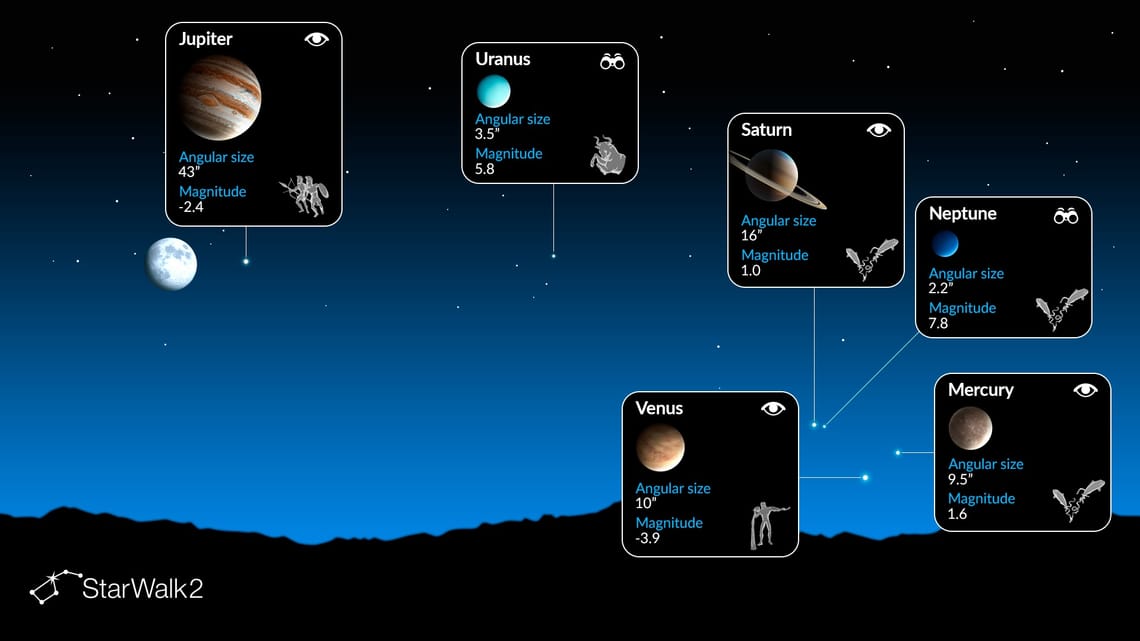
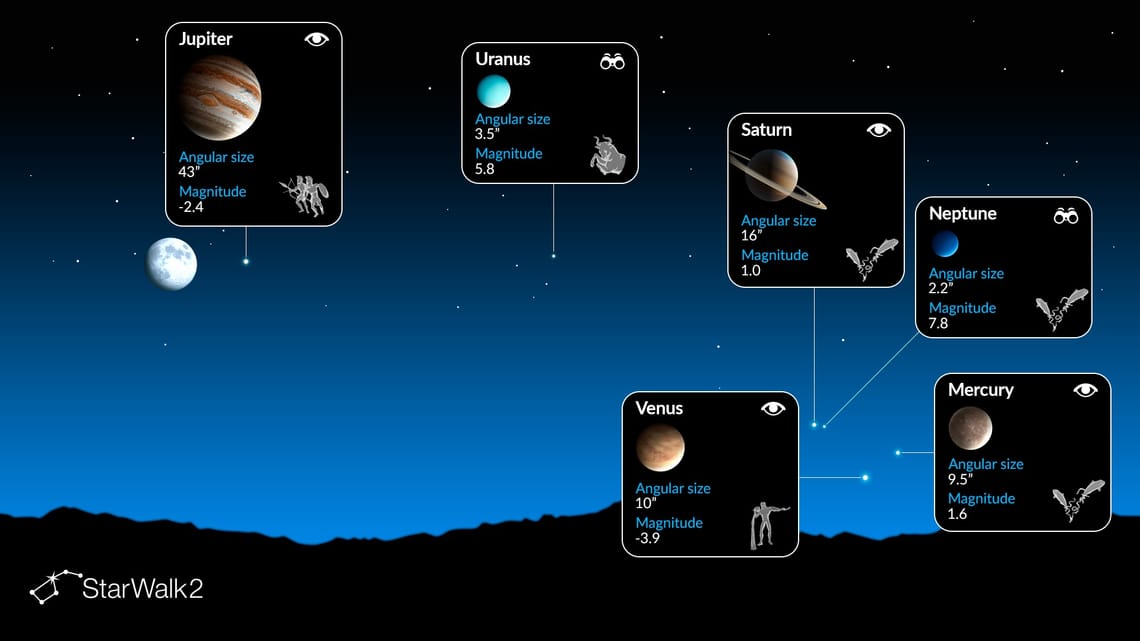
ในช่วงที่ดาวเคราะห์เรียงตัวกันในวันที่ 28 กุมภาพันธ์ จะสามารถมองเห็น ดาวเคราะห์ได้ 6 ดวง ในท้องฟ้ายามเย็น แต่ ไม่ใช่ทุกดวงจะมองเห็นได้ง่ายเท่ากันบางดวงส่องสว่างจ้า ในขณะที่บางดวงมีแสงสว่างน้อยกว่าและต้องใช้กล้องส่องทางไกลหรือกล้องโทรทรรศน์ ต่อไปนี้คือรายชื่อดาวเคราะห์เหล่านั้น เรียงลำดับตามความง่ายในการมองเห็นจากง่ายที่สุดไปจนถึงยากที่สุด
ดาวเคราะห์ที่มองเห็นได้ด้วยตาเปล่า:
- ดาวศุกร์ (ความสว่าง −3.9) — วัตถุที่สว่างที่สุดในท้องฟ้า (รองจากดวงจันทร์)
- ดาวพฤหัสบดี (ความสว่าง −2.4) — สว่างไสวและมองเห็นได้ชัดเจนเช่นกัน
- ดาวเสาร์ (ความสว่าง 1.0) — สว่างปานกลางและมองเห็นได้ง่าย
- ดาวพุธ (ความสว่าง 1.6) — เล็กและไม่ค่อยเด่นชัด
ดาวเคราะห์ที่ต้องการอุปกรณ์ทางแสง:
- ดาวเนปจูน (ความสว่าง 5.8) — ต้องใช้กล้องส่องทางไกล
- ดาวเนปจูน (ความสว่าง 7.8) — ต้องใช้กล้องส่องทางไกลกำลังสูงหรือกล้องโทรทรรศน์
เพื่อช่วยคุณวางแผนการสังเกตการณ์ ตารางด้านล่างนี้สรุปตำแหน่งที่ตั้งของดาวเคราะห์แต่ละดวง (ในซีกโลกเหนือ) และระบุว่าคุณจำเป็นต้องใช้กล้องส่องทางไกลหรือกล้องโทรทรรศน์ในการมองเห็น
| ดาวเคราะห์ | มองด้วยตาเปล่า? | ที่ไหนบนท้องฟ้า | มองเห็นได้นานแค่ไหนหลังพระอาทิตย์ตกดิน |
|---|---|---|---|
| ปรอท | ใช่ (ท้าทาย) | อยู่ต่ำมากในท้องฟ้าทางทิศตะวันตก | ประมาณ 1 ชั่วโมง |
| ดาวศุกร์ | ใช่ | อยู่ต่ำมากในท้องฟ้าทางทิศตะวันตก | ประมาณ 1 ชั่วโมง |
| ดาวเสาร์ | ใช่ | ต่ำในท้องฟ้าทางทิศตะวันตก | ~1.5 ชั่วโมง |
| ดาวพฤหัสบดี | ใช่ | สูงในท้องฟ้าทางทิศตะวันออกถึงทิศตะวันออกเฉียงใต้ | เกือบทั้งคืน |
| ยูเรนัส | เลขที่ | สูงขึ้นไปในท้องฟ้าทางทิศตะวันตกเฉียงใต้ถึงทิศตะวันตก | จนถึงประมาณเที่ยงคืน (โดยใช้กล้องส่องทางไกล) |
| ดาวเนปจูน | เลขที่ | ต่ำในท้องฟ้าทางทิศตะวันตก | ~1.5 ชั่วโมง (รวมเลนส์) |
ด้านล่างนี้ คุณจะพบ รายละเอียดเกี่ยวกับดาวเคราะห์ แต่ละดวง โดยอธิบายตำแหน่งที่ปรากฏบนท้องฟ้าและวิธีที่สามารถมองเห็นได้เปลี่ยนแปลงไปในช่วงเย็น
ดาวพุธ: ปรากฏตัวสั้นๆ ในช่วงเย็น
ในวันที่ 28 กุมภาพันธ์ 2026 ดาวพุธ จะใกล้สิ้นสุดช่วงเวลาที่มองเห็นได้ในตอนเย็น หลังจากที่อยู่ ห่างจากดวงอาทิตย์มากที่สุด เมื่อต้นเดือน ดาวพุธจะปรากฏอยู่ ต่ำมากเหนือขอบฟ้าทางทิศตะวันตกในกลุ่มดาว ปลาหลังจากพระอาทิตย์ตกดินไม่นาน
เนื่องจากดาวพุธตกเร็วมาก จึงจะมองเห็นได้เพียง ช่วงเวลาสั้นๆ เท่านั้น อาจน้อยกว่าหนึ่งชั่วโมง เริ่มสังเกตการณ์ ทันทีที่ท้องฟ้ามืดลง และตรวจสอบให้แน่ใจว่าคุณ มองเห็นเส้นขอบฟ้าได้อย่างชัดเจนและไม่มีสิ่งกีดขวาง
ดาวศุกร์: หลักนำทางอันสว่างไสว
คุณจะมองเห็น ดาวศุกร์ ได้ไม่ยากเลย ด้วยความสว่าง ระดับ −3.9 ในกลุ่มดาว คนแบก น้ำ ดาวศุกร์จะอยู่เด่นทางทิศตะวันตกของท้องฟ้า และเป็น จุดอ้างอิงที่ง่ายที่สุด ในการค้นหาดาวพุธและดาวเคราะห์ดวงอื่นๆ
แม้ว่าดาวศุกร์จะเป็นดาวเคราะห์ที่สว่างที่สุดในการเรียงตัวของดาวฤกษ์ แต่ก็จะอยู่ ต่ำมากบนท้องฟ้าจึงจำเป็นต้อง สังเกตการณ์ในช่วงเย็น และต้องมี ขอบฟ้าด้านทิศ ตะวันตกที่ปลอดโปร่ง
ในช่วงเย็นของ วัน ที่ 27 กุมภาพันธ์ดาวศุกร์จะโคจรผ่านใกล้ดาวพุธในระยะห่างประมาณ 5 องศา ส่วนในวันที่ 28 กุมภาพันธ์ ดาวเคราะห์ทั้งสองดวงจะยังคงอยู่ใกล้กัน แต่เนื่องจาก อยู่ใกล้ดวงอาทิตย์และอยู่ต่ำเหนือขอบฟ้า จึงทำให้มองเห็นได้ยากขึ้น
ดาวเสาร์: มั่นคงและงดงามดุจทองคำ
เมื่ออยู่เหนือดาวศุกร์ขึ้นไปเล็กน้อย ดาวเสาร์ จะส่อง แสงสีเหลืองนวล อันเป็นเอกลักษณ์ ในกลุ่มดาว ปลาต่างจากดาวฤกษ์ทั่วไป แสงของดาวเสาร์จะคงที่และไม่กระพริบ นั่นคือวิธีที่คุณสามารถจดจำมันได้ หรือคุณสามารถใช้ แอป Star Walk 2 ก็ได้ !
ตำแหน่งของดาวเสาร์ทำให้มันเป็นสะพานเชื่อมที่สำคัญระหว่างดาวเคราะห์ในขอบฟ้าต่ำ (ดาวพุธและดาวศุกร์) กับส่วนที่สูงขึ้นไปของแนวดาวเคราะห์
ดาวเนปจูน: เพื่อนบ้านที่แสนจะลึกลับของดาวเสาร์
ดาวเนปจูน จะอยู่ ใกล้กับดาวเสาร์มาก ในกลุ่ม ดาวปลา โดยอยู่ห่างกันประมาณ 1 องศาเท่านั้น ! แม้ว่าจะมองไม่เห็นด้วยตาเปล่า แต่ก็สามารถมองเห็นได้ด้วย กล้องส่องทางไกลหรือกล้องโทรทรรศน์ขนาดเล็ก ในที่มืด
หากคุณสามารถมองเห็นดาวเสาร์ได้ก่อน การค้นหาดาวเนปจูนก็จะง่ายขึ้นมาก โดยการสแกนพื้นที่ใกล้เคียง
ดาวยูเรนัส: สูงขึ้นไปบนท้องฟ้า แต่กลับมองเห็นได้ยากขึ้น
ดาวเคราะห์ยูเรนัส จะปรากฏอยู่ สูงกว่าขอบฟ้ามากในกลุ่มดาว วัวแม้ว่าในทางเทคนิคแล้วจะสามารถมองเห็นได้โดยไม่ต้องใช้กล้องส่องทางไกลภายใต้สภาพท้องฟ้ามืดสนิท แต่ ขอแนะนำอย่างยิ่งให้ใช้กล้องส่องทางไกล
นอกจากนี้ ดาวเนปจูนจะอยู่ไม่ไกลจาก กระจุกดาวลูกไก่ โดยมีระยะห่างประมาณ 5 องศา กระจุกดาวลูกไก่ (ซึ่งสามารถมองเห็นได้ด้วยตาเปล่าในท้องฟ้าที่มืดมิด) จะช่วยให้คุณค้นหาดาวเคราะห์ที่ริบหรี่นี้ได้เร็วขึ้น
ดาวพฤหัสบดี: ยักษ์แสงเจิดจรัสแห่งทิศตะวันออกเฉียงใต้
อีกด้านหนึ่งของท้องฟ้า— สูงขึ้นไปทางทิศตะวันออกเฉียงใต้ — ดาวพฤหัสบดี จะส่องแสงสว่างไสว มันจะอยู่ในกลุ่มดาว คนคู่ไม่ไกลจากดาวฤกษ์สว่างอย่างดาว แคสเตอร์และ ดาวพอลลักซ์
ข้อดีคือ ดวงจันทร์ที่สว่างถึง 90% จะปรากฏอยู่ ใกล้ดาวพฤหัสบดีมาก โดยระยะห่างระหว่างทั้งสองจะอยู่ที่ประมาณ 4 องศา แต่ข้อเสียคือ ดวงจันทร์ที่เกือบเต็มดวงจะทำให้ท้องฟ้าสว่างขึ้น ทำให้ มองเห็นดาวเคราะห์ที่จางๆ เช่น ดาวยูเรนัสได้ยากขึ้น
ลองใช้กล้องส่องทางไกลมองลงไปใต้ดวงจันทร์เพื่อมองหากระจุกดาวรังผึ้ง (M44) ซึ่งเป็นหนึ่งในกระจุกดาวเปิดที่สว่างที่สุด เป็นเป้าหมาย “เสริม” ที่สังเกตได้ง่ายและทำให้การสังเกตการณ์ครั้งนี้คุ้มค่ามากยิ่งขึ้น
การจัดเรียงตัวของดวงดาวเปลี่ยนแปลงอย่างไรในระหว่างคืน
การเรียงตัวของดาวเคราะห์ในวันที่ 28 กุมภาพันธ์ จะ เห็นได้ชัดเจนที่สุดหลังจากพระอาทิตย์ตกดินไม่นานนี่คือสิ่งที่จะเกิดขึ้นกับดาวเคราะห์ต่างๆ เมื่อเวลาผ่านไปในตอนเย็น:
- ดาวพุธและดาวศุกร์ จะตกก่อน
- ดาวเสาร์และดาวเนปจูน จะตามมา
- ดาวเนปจูน จะยังคงมองเห็นได้นานกว่าเดิม
- ดาวพฤหัสบดี จะตกเป็นดวงสุดท้าย
ด้วยเหตุนี้ การกำหนดเวลาจึงมีความสำคัญอย่างยิ่ง โดยเฉพาะอย่างยิ่งหากคุณต้องการดูดาวเคราะห์ทั้งหกดวงในคราวเดียว ด้านล่างนี้ เราจะแสดงวิธีง่ายๆ ในการทำเช่นนั้นให้คุณดู
วิธีการค้นหาดาวเคราะห์ทั้งหกดวงได้อย่างง่ายดาย
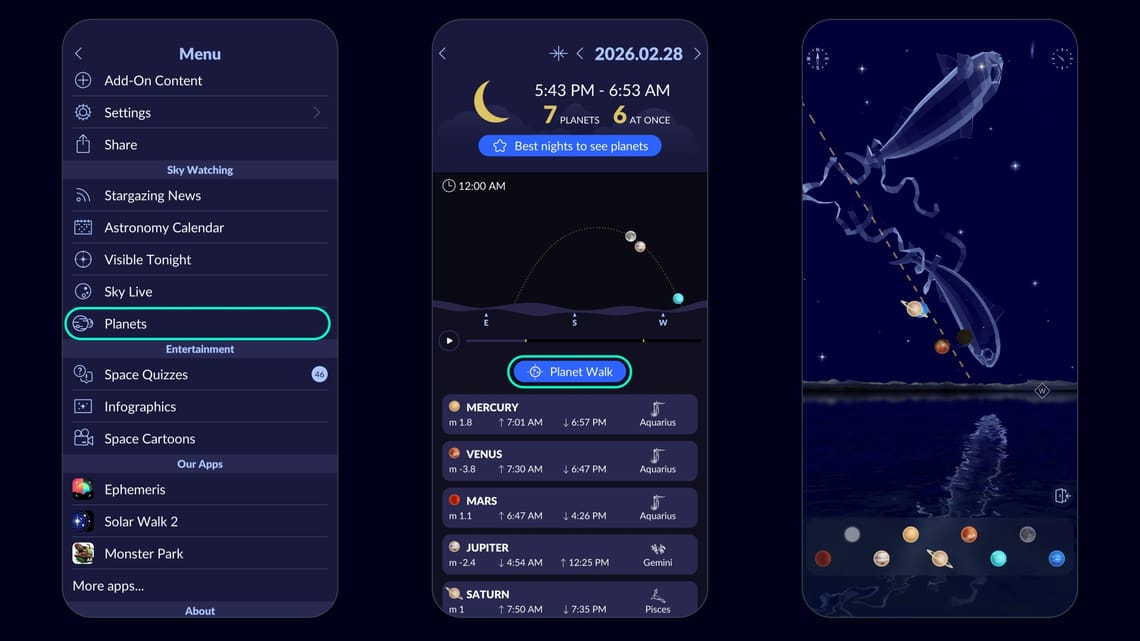
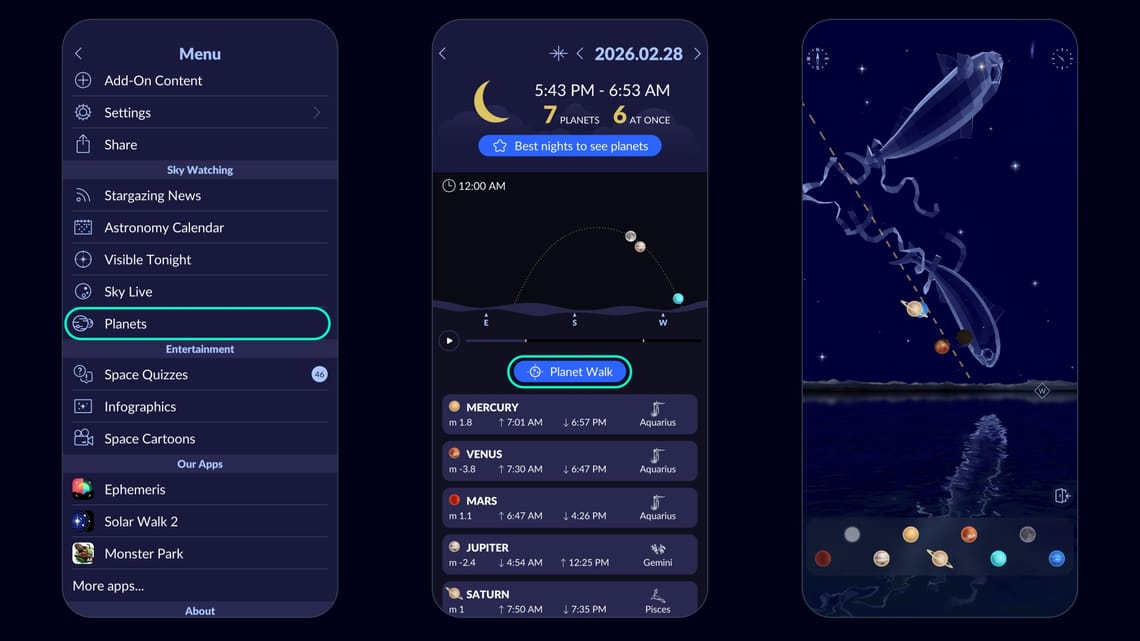
วิธี ที่ง่ายและเร็วที่สุด ในการสังเกตดาวเคราะห์ทั้งหกดวงคือการใช้ ฟีเจอร์ Planet Walk ใน แอป Star Walk 2 ฟรีนี่คือวิธีการใช้งาน:
©Vito Technology, Inc.
-
- เปิดเกม Star Walk 2 แล้วไปที่ เมนู > ดาวเคราะห์
- แตะ ปุ่ม Planet Walk หรือ เลือกดาวเคราะห์ดวงใดก็ได้ ในรายการ
- หันโทรศัพท์ของคุณไปทางท้องฟ้าเพื่อเปรียบเทียบแผนที่กับวัตถุทางดาราศาสตร์จริง
- แตะที่ ไอคอนดาวเคราะห์ดวงใดก็ได้ แล้วทำตามลูกศรเพื่อค้นหาดาวเคราะห์ดวงนั้นบนท้องฟ้าของคุณ
- แตะ ไอคอนกล้อง เพื่อเปิด โหมด AR สำหรับมุมมองภาพซ้อนท้องฟ้าที่สมจริงยิ่งขึ้น
Planet Walk จะแสดงดาวเคราะห์ทั้งหมดพร้อมกัน ซึ่งเป็นสิ่งที่แอปดูดาวส่วนใหญ่ทำไม่ได้
ควรดูที่ไหนเพื่อสังเกตการเรียงตัวของดาวเคราะห์ในวันที่ 28 กุมภาพันธ์ 2026?
©Vito Technology, Inc.
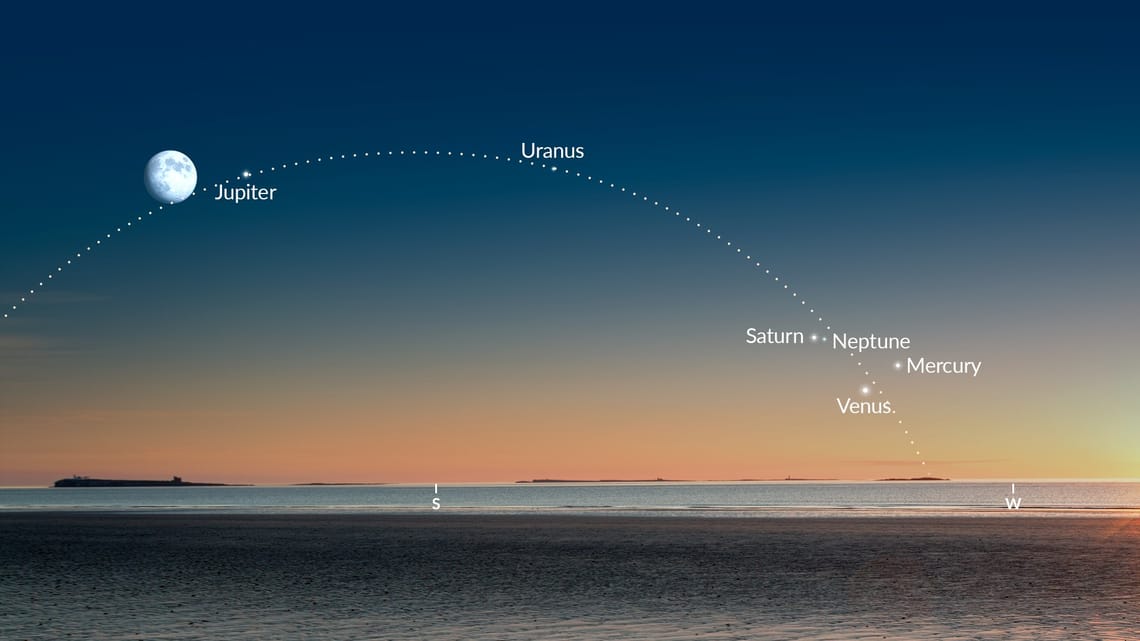
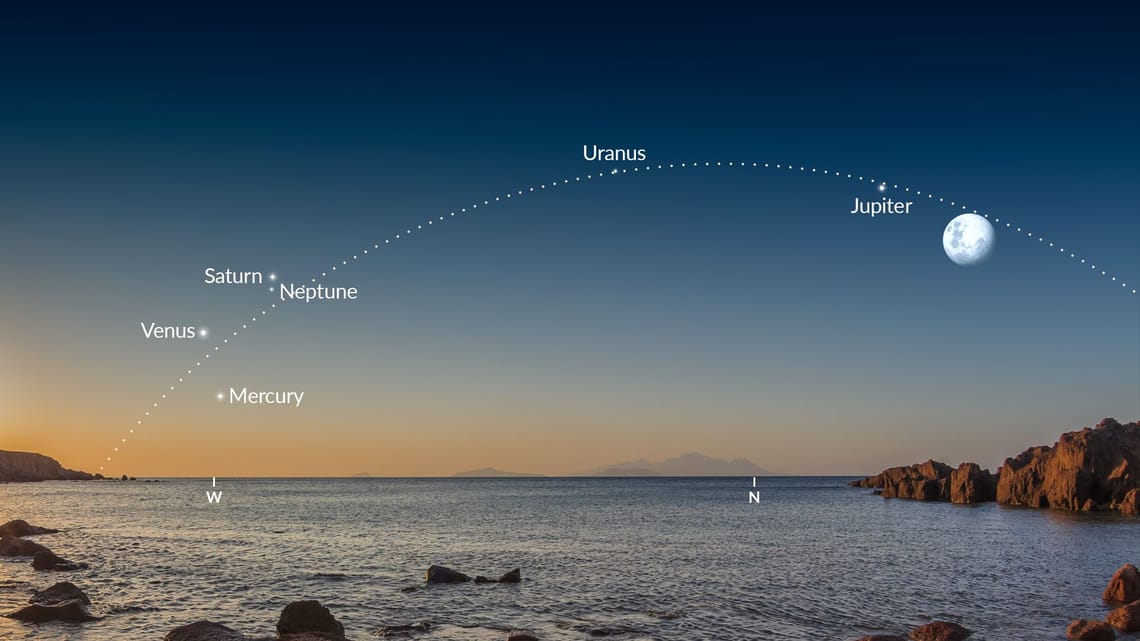
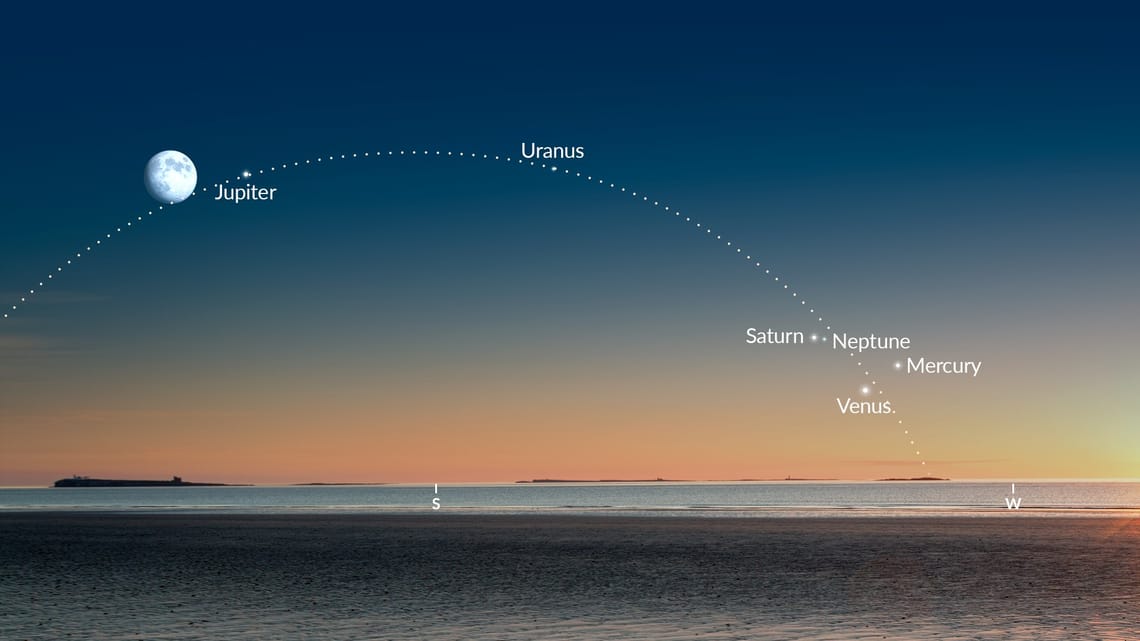
ในเย็นวันที่ 28 กุมภาพันธ์ ดาวเคราะห์ทั้งหกดวงจะปรากฏกระจายอยู่บนท้องฟ้า จากทิศตะวันตกไปทิศตะวันออกนี่คือตำแหน่งที่คุณควรสังเกตเพื่อดูดาวเคราะห์เหล่านั้น:
- ทิศตะวันตก / ตะวันตกเฉียงใต้: ดาวพุธ ดาวศุกร์ ดาวเสาร์ ดาวเนปจูน
- ทิศตะวันตกเฉียงใต้ (สูงขึ้นไปบนท้องฟ้า): ดาวยูเรนัส
- ทิศตะวันออกเฉียงใต้: ดาวพฤหัสบดี ใกล้กับดวงจันทร์ที่สว่างไสว
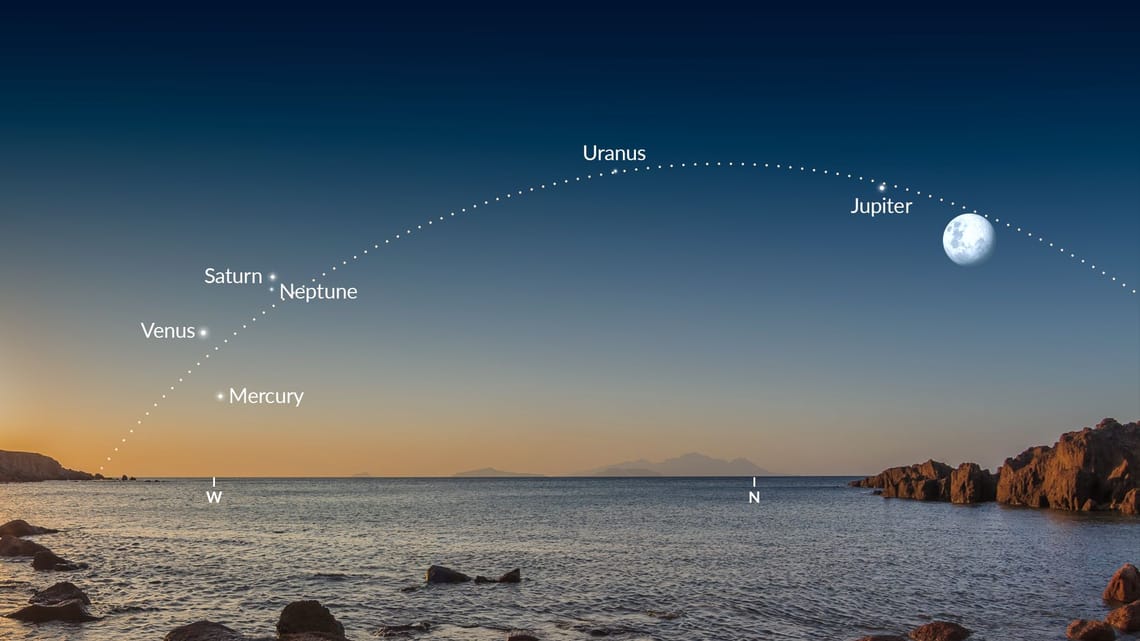
ดาวเคราะห์ต่างๆ จะเคลื่อนตัวเป็นรูปโค้งอย่างนุ่มนวลบนท้องฟ้า โดยตาม แนวสุริยวิถี ซึ่งเป็นเส้นทางที่ดวงอาทิตย์โคจรตลอดทั้งปี
โปรดทราบว่า ในซีกโลกใต้รูปแบบโดยรวมจะคล้ายกัน แต่แนวโค้งของการจัดเรียงจะเอียงไปใน ทิศทางตรงกันข้าม
©Vito Technology, Inc.
เคล็ดลับง่ายๆ สำหรับการชมปรากฏการณ์ “ขบวนพาเหรด” ดาวเคราะห์ในเดือนกุมภาพันธ์ 2026
การพลาดชมดาวพุธและดาวเสาร์ส่วนใหญ่เกิดจากสองสาเหตุหลัก คือ ขอบฟ้าด้านทิศตะวันตกถูกบดบัง (ต้นไม้/อาคาร) และหมอกระดับต่ำที่บดบังดาวพุธและดาวเสาร์ในช่วงพลบค่ำ ใช้รายการตรวจสอบนี้เพื่อเพิ่มโอกาสในการชมดาวพุธและดาวเสาร์ให้มากที่สุดในช่วงเวลาสั้นๆ ในตอนเย็น
- เริ่มสังเกตการณ์ ทันทีที่ท้องฟ้าเริ่มมืดลง
- เลือกสถานที่ที่มี ทัศนียภาพทางทิศตะวันตกที่ชัดเจน
- หากต้องการชมดาวยูเรนัสและดาวเนปจูนควรนำ กล้องส่องทางไกลกำลังสูง หรือกล้องโทรทรรศน์ไปด้วย
- ข้อควรระวัง: ห้ามหันกล้องส่องทางไกลหรือกล้องโทรทรรศน์ไปใกล้ดวงอาทิตย์เด็ดขาด
- หากคุณใช้กล้องส่องทางไกลใกล้ขอบฟ้าทางทิศตะวันตก ให้รอจนกว่าดวงอาทิตย์จะตกดินสนิท และอย่ากวาดสายตาไปใกล้ตำแหน่งของดวงอาทิตย์มากเกินไป
- อย่ารอช้านะ — ดาวพุธจะตกเร็วมาก!
- โปรดจำไว้ว่า ดาวเคราะห์จะส่องแสงอย่างสม่ำเสมอ นั่นคือวิธีที่คุณสามารถแยกแยะดาวเคราะห์ออกจากดาวฤกษ์ที่กระพริบได้
เพื่อให้แน่ใจอย่างที่สุดว่าคุณกำลังมองดูดาวเคราะห์ ไม่ใช่ดาวฤกษ์ ให้ใช้ แอปStar Walk 2 เพื่อระบุวัตถุบนท้องฟ้าแบบเรียลไทม์
คำถามที่พบบ่อย: การเรียงตัวของดาวเคราะห์ในวันที่ 28 กุมภาพันธ์ 2026
การเรียงตัวของดาวเคราะห์คืออะไร?
การเรียงตัวของดาวเคราะห์ (มักเรียกว่า “ขบวนดาวเคราะห์”) คือปรากฏการณ์ที่ดาวเคราะห์หลายดวงปรากฏอยู่รวมกันตามแนวสุริยวิถีเมื่อมองจากโลก สำหรับคำอธิบายโดยละเอียด (และปรากฏการณ์การเรียงตัวของดาวเคราะห์อื่นๆ ที่กำลังจะเกิดขึ้น) โปรดดู คู่มือขบวนดาวเคราะห์ ของเรา
ทำไมเดือนกุมภาพันธ์ 2026 ถึงกำลังเป็นที่นิยม?
เดือนกุมภาพันธ์ 2026 กำลังเป็นที่พูดถึงอย่างมาก เนื่องจากจะมีปรากฏการณ์ “ขบวนดาวเคราะห์” ที่หาได้ยากเกิดขึ้นประมาณวันที่ 28 กุมภาพันธ์ 2026 ซึ่งก็คือดาวเคราะห์ 6 ดวงจะปรากฏบนท้องฟ้าในยามเย็นหลังพระอาทิตย์ตกดินไม่นาน นาซายังได้เน้นย้ำวันที่ 28 กุมภาพันธ์ว่าเป็น “ขบวนดาวเคราะห์” ใน รายการปรากฏการณ์ทางท้องฟ้าที่น่าสนใจในปี 2026 อีก ด้วย
ดาวเคราะห์ดวงใดบ้างที่จะเรียงตัวกันในวันที่ 28 กุมภาพันธ์ 2026?
ดาวเคราะห์หกดวงมีส่วนร่วมในการเรียงตัวครั้งนี้ ได้แก่ ดาวพุธ ดาวศุกร์ ดาวเสาร์ ดาวพฤหัสบดี ดาวยูเรนัส และดาวเนปจูน (การมองเห็นขึ้นอยู่กับตำแหน่งของคุณและสภาพท้องฟ้าในท้องถิ่น)
ดาวเคราะห์ทั้งหกดวงจะสามารถมองเห็นได้ด้วยตาเปล่าหรือไม่?
ไม่ครับ ภายใต้สภาพอากาศที่ดี สามารถมองเห็น ดาวพุธ ดาวศุกร์ ดาวเสาร์ และดาวพฤหัสบดี ได้โดยไม่ต้องใช้กล้องโทรทรรศน์ ส่วนดาวยูเรนัสและดาวเนปจูน นั้นสว่างน้อยกว่ามาก และโดยปกติแล้วต้องใช้ กล้องส่องทางไกลหรือกล้องโทรทรรศน์ครับ
เวลาไหนเหมาะสมที่สุดสำหรับการตรวจสอบการจัดเรียงแนวแกน?
ในสถานที่ส่วนใหญ่ ช่วงเวลาที่ดีที่สุดจะเริ่มต้น ประมาณ 30 นาทีหลังจากพระอาทิตย์ตกดินตามเวลาท้องถิ่น เวลาที่แน่นอนขึ้นอยู่กับละติจูดของคุณและความชัดเจนของขอบฟ้าทางทิศตะวันตก
ช่วงเวลาใดเหมาะสมที่สุดในการชมการเรียงตัวของดาวในสหรัฐอเมริกา?
ในสหรัฐอเมริกา ให้เริ่มประมาณ 30 นาทีหลังจากพระอาทิตย์ตกดินตามเวลาท้องถิ่น และมองต่ำๆ ไปทางทิศตะวันตก ช่วงที่ดาวพุธและดาวศุกร์ปรากฏให้เห็นนั้นสั้นมาก ดังนั้นควรพยายามสังเกตภายในชั่วโมงแรกหลังจากพระอาทิตย์ตกดิน
ช่วงเวลาใดเหมาะสมที่สุดในการชมการเรียงตัวของดวงอาทิตย์ในสหราชอาณาจักร (อังกฤษ)?
ในสหราชอาณาจักร (รวมถึงอังกฤษ) กลุ่มดาวพุธจะหนาแน่นที่สุดประมาณวันที่ 1 มีนาคม เริ่มสังเกตประมาณ 30 นาทีหลังพระอาทิตย์ตกดินตามเวลาท้องถิ่น โดยให้เห็นขอบฟ้าทางทิศตะวันตกที่โล่ง – ดาวพุธอาจอยู่ต่ำมากและสังเกตได้ยากในแสงสนธยาที่สว่างจ้า
ฉันควรเงยหน้ามองไปทางไหนบนท้องฟ้า?
ลองมองไปตาม เส้นสุริยวิถี (เส้นทางที่ดวงอาทิตย์และดาวเคราะห์โคจร) ในวันนี้ ดาวพุธ ดาวศุกร์ และดาวเสาร์ จะอยู่ ต่ำใกล้กับทิศทางที่พระอาทิตย์ตกในขณะที่ ดาวพฤหัสบดี จะอยู่ สูงขึ้นไป บนท้องฟ้ามาก
เหตุใดจึงยากที่จะมองเห็นดาวพุธ (และบางครั้งดาวเสาร์)?
ดาวพุธโคจรอยู่ใกล้ดวงอาทิตย์บนท้องฟ้า ดังนั้นจึงอยู่ ต่ำมากใกล้ขอบฟ้า และตกดินไม่นานหลังจากพระอาทิตย์ตกดิน ดาวเสาร์ก็อาจมองเห็นได้ จางๆ ในช่วงพลบค่ำ โดยเฉพาะอย่างยิ่งหากมีหมอกหรือมลภาวะทางแสง
ฉันจำเป็นต้องใช้กล้องโทรทรรศน์เพื่อมองเห็นดาวยูเรนัสและดาวเนปจูนหรือไม่?
กล้องโทรทรรศน์ช่วยได้ แต่ กล้องส่องทางไกลก็อาจเพียงพอ โดยเฉพาะอย่างยิ่งสำหรับการสังเกตดาวยูเรนัส ส่วนดาวเนปจูนนั้นจางกว่าและสังเกตได้ยากกว่า ดังนั้นกล้องโทรทรรศน์ (และท้องฟ้าที่มืดสนิท) จะทำให้การสังเกตง่ายขึ้นมาก
การเรียงตัวแบบนี้หายากไหม?
การเห็นดาวเคราะห์หลายดวงบนท้องฟ้าในค่ำคืนเดียวกันนั้นไม่ใช่เรื่องแปลกมากนัก แต่ การเห็นดาวเคราะห์จำนวนมากเรียงตัวกันในตำแหน่งที่สะดวกต่อการสังเกต (โดยเฉพาะอย่างยิ่งดาวเคราะห์หลายดวงที่มองเห็นได้ด้วยตาเปล่า) นั้นเป็นเรื่องพิเศษ และคุ้มค่าที่จะวางแผนล่วงหน้า
การเรียงตัวของดาวเคราะห์หกดวงในวันที่ 28 กุมภาพันธ์ 2026: ข้อสรุป
การเรียงตัวของดาวเคราะห์ในวันที่ 28 กุมภาพันธ์ 2026 เป็นปรากฏการณ์ที่พลาดไม่ได้สำหรับทั้งผู้เริ่มต้นและผู้สังเกตการณ์ท้องฟ้าที่มีประสบการณ์ ด้วยเวลาที่เหมาะสมในตอนเย็น การ “เคลื่อนตัว” ของดาวเคราะห์ครั้งนี้มอบโอกาสอันหาได้ยากในการเห็น ดาวเคราะห์ถึงหกดวงพร้อมกัน ! นอกจากนี้ ดวงจันทร์ที่สว่างเกือบเต็มดวงใกล้ดาวพฤหัสบดี จะทำให้ภาพที่เห็นยิ่งน่าประทับใจมากขึ้น
หากคุณกำลังมองหาคำจำกัดความของ “ขบวนดาวเคราะห์” และภาพรวมตลอดทั้งปีของการเรียงตัวของดาวเคราะห์อื่นๆ โปรดดู คำอธิบายเกี่ยวกับขบวนดาวเคราะห์ ของ เรา
ต้องการทราบตำแหน่งที่แน่นอนของคุณแบบเรียลไทม์หรือไม่? ดาวน์โหลด แอป Star Walk 2 ฟรี และใช้ ฟีเจอร์ Planet Walk เพื่อนำทางคุณไปทั่วท้องฟ้าจากดาวเคราะห์ดวงหนึ่งไปยังอีกดวงหนึ่ง
ท้องฟ้าแจ่มใส!
Feb 25, 2026
Around Feb 28, 2026, six planets are above the horizon after sunset. They don’t cluster in one place — they stretch across the sky. Start 30–60 minutes after local sunset: low west (Mercury, Venus, Saturn), then high southeast/east (Jupiter). Uranus and Neptune are faint and require optics. Use Star Walk 2 to get exact guidance in real time.
Contents
- February 28, 2026 planet alignment: Key details
- Reality check: what you’ll actually see (and what “success” looks like)
- What Happens During the Planetary Alignment on February 28?
- When to See Six Planets Align?
- Where to Look to See the Planetary Alignment on February 28, 2026?
- Quick Tips for Observing the February 2026 Planet “Parade”
-
FAQ: Planetary alignment on February 28, 2026
- What is a planetary alignment?
- Why is February 2026 trending?
- Which planets will align on February 28, 2026?
- Will all six planets be visible to the naked eye?
- What time is the best to see the alignment?
- What time is the best to see the alignment in the United States?
- What time is the best to see the alignment in the UK (England)?
- Where should I look in the sky?
- Why is Mercury (and sometimes Saturn) hard to spot?
- Do I need a telescope to see Uranus and Neptune?
- Is this alignment rare?
- Six-Planet Alignment on February 28, 2026: Bottom Line
February 28, 2026 planet alignment: Key details
- Date: February 28, 2026
- Best time: About 30 minutes after local sunset
- Where to look: From low in the west (Mercury/Venus/Saturn) to high in the east (Jupiter)
- Visible to the naked eye: Mercury, Venus, Saturn, Jupiter
- Binoculars or a telescope needed: Uranus, Neptune
New to the term “planet alignment” or “planet parade”? Read our guide: What Is a Planet Parade? Planetary Alignment Explained.
Quick viewing times (US & UK)
The best window starts about 30 minutes after local sunset. Here are approximate “start looking” times for a few major cities:
| City | Best date | Local sunset | Start looking (~+30 min) |
|---|---|---|---|
| New York | Feb 28 | 5:45 PM | 6:15 PM |
| Washington, DC | Feb 28 | 5:59 PM | 6:29 PM |
| Chicago | Feb 28 | 5:39 PM | 6:09 PM |
| Dallas | Feb 28 | 6:23 PM | 6:53 PM |
| Denver | Feb 28 | 5:50 PM | 6:20 PM |
| Phoenix | Feb 28 | 6:24 PM | 6:54 PM |
| Los Angeles | Feb 28 | 5:48 PM | 6:18 PM |
| Seattle | Feb 28 | 5:52 PM | 6:22 PM |
| London (England) | Mar 1 | 5:40 PM | 6:10 PM |
| Manchester (England) | Mar 1 | 5:46 PM | 6:16 PM |
Times are approximate. For your exact location and horizon, use the skywatching app Star Walk 2.
Reality check: what you’ll actually see (and what “success” looks like)
Yes, six planets are above the horizon around Feb 28 — but seeing all six is a different challenge.
Most people will easily spot Jupiter and Venus. Saturn is doable, but it can look faint in bright twilight. Mercury is the “blink-and-you-miss-it” planet: it sits very low and drops fast after sunset. Uranus usually needs binoculars, and Neptune is typically a telescope target.
So don’t judge your session by “all six or nothing”. A great result is:
- Level 1 (easy): Jupiter + Venus
- Level 2 (good): add Saturn and/or Mercury
- Level 3 (challenge mode): Uranus (binoculars) + Neptune (telescope, dark sky)
What Happens During the Planetary Alignment on February 28?
On Feb 28, 2026, six planets are above the horizon on the same evening — which is why this date is widely shared as a “planetary parade”.
What you’ll actually notice in the sky is a gentle arc of planets along the ecliptic (a line‑of‑sight effect, not a perfect straight line in space) — with four bright planets being the main show and two faint ones as a binocular/telescope challenge.
©Vito Technology, Inc.
NASA highlights this date as a “Planetary Parade” — and the main reason it’s special is that several bright planets are visible at once without optical aid.
This parade will include:
- Mercury
- Venus
- Saturn
- Jupiter
- Uranus
- Neptune
Such celestial events are pretty uncommon, especially when four bright planets can be seen at once without any optical aid. What makes this “parade” even more special is its evening visibility, which is more convenient for most observers than early-morning alignments. If you want the general explanation of what counts as a “planet parade” (and other upcoming alignments), read our Planet Parade guide.
When to See Six Planets Align?
This is a late‑February / early‑March event, not a single 5‑minute moment: different places get their “tightest lineup” on slightly different evenings.
- Main date: February 28, 2026
- Best time: during the first hour after local sunset (Mercury is time‑sensitive)
- Visibility window: late February to early March (varies by location)
February 28 is a median date — the moment when the planets appear most tightly grouped for many locations worldwide. Depending on where you live, the best viewing date may fall a few days earlier or later.
Best Dates to See the Planet Parade by Location
Here are example dates when the planets gather in the smallest sector of the sky:
- São Paulo: February 25
- Athens: February 28
- New York: February 28
- Mexico City: February 28
- Tokyo: February 28
- Beijing: March 1
- Berlin: March 1
- London: March 1
- Mumbai: March 1
- Reykjavík: March 2
To choose the best viewing date and time for your location, use the Planet Walk feature in the Star Walk 2 app.
Which Planets Will Be Visible During the Planetary Alignment?
©Vito Technology, Inc.
During the planetary alignment on February 28, six planets will be visible in the evening sky, but not all of them will be equally easy to spot. Some shine brightly, while others are fainter and require binoculars or a telescope. Here they are, arranged by visibility from easiest to most challenging to observe.
Naked-eye planets:
- Venus (mag −3.9) — the brightest object in the sky (after the Moon)
- Jupiter (mag −2.4) — also brilliant and unmistakable
- Saturn (mag 1.0) — moderately bright and easy to spot
- Mercury (mag 1.6) — small and subtle
Planets requiring optics:
- Uranus (mag 5.8) — binoculars required
- Neptune (mag 7.8) — powerful binoculars or a telescope required
To help you plan your observation, the table below summarizes where to find each planet (in the Northern Hemisphere) and whether you need binoculars or a telescope to see it.
| Planet | Naked eye? | Where in the sky | How long visible after sunset |
|---|---|---|---|
| Mercury | Yes (challenging) | Very low in the western sky | ~1 hour |
| Venus | Yes | Very low in the western sky | ~1 hour |
| Saturn | Yes | Low in the western sky | ~1.5 hours |
| Jupiter | Yes | High in the eastern to southeastern sky | Most of the night |
| Uranus | No | High in the southwestern to western sky | Until around midnight (with optics) |
| Neptune | No | Low in the western sky | ~1.5 hours (with optics) |
Below, you’ll find a planet-by-planet breakdown explaining where each one appears in the sky and how its visibility changes during the evening.
Mercury: A Brief Evening Appearance
On February 28, 2026, Mercury will be nearing the end of its evening visibility period after reaching its greatest separation from the Sun earlier in the month. It will appear very low above the western horizon, in the constellation Pisces, shortly after sunset.
Because Mercury sets quickly, it will be visible only for a short amount of time — probably less than one hour. Start observing as soon as the sky darkens and make sure you have a clear, unobstructed view of the horizon.
Venus: The Bright Guidepost
Venus will be impossible to miss. Shining at magnitude −3.9 in the constellation Aquarius, it will dominate the western sky and serve as the easiest reference point for locating Mercury and the other planets.
Although Venus is the brightest planet in the alignment, it will also sit very low in the sky, requiring early-evening observation and a clear western horizon.
On the evening of February 27, Venus will pass about 5° from Mercury. On February 28, the two planets will still appear close together. However, their proximity to the Sun and low elevation above the horizon will make them harder to spot.
Saturn: Steady and Golden
Slightly higher above Venus, Saturn will glow with its characteristic soft yellow light in the constellation Pisces. Unlike stars, its light will appear steady and non-twinkling — that’s how you can recognize it. Or you can simply use the Star Walk 2 app!
Saturn’s position makes it an important visual bridge between the low-horizon planets (Mercury and Venus) and the higher parts of the alignment.
Neptune: A Subtle Neighbor of Saturn
Neptune will be located very close to Saturn in the constellation Pisces — about 1° away! Although invisible to the naked eye, it can be detected with binoculars or a small telescope under dark skies.
If you can spot Saturn first, Neptune becomes much easier to locate by scanning the area nearby.
Uranus: Higher in the Sky, But Harder to See
Uranus will appear much higher above the horizon, in the constellation Taurus. While it can technically be seen without optical aid under perfect dark-sky conditions, binoculars are strongly recommended.
Moreover, Uranus will be located not far from the Pleiades star cluster — the distance between them will be about 5°. The Pleiades (which are visible to the naked eye under dark skies) can help you find the faint planet quicker.
Jupiter: The Dazzling Giant in the Southeast
On the opposite side of the sky — high in the southeast — Jupiter will shine brightly. It will be positioned in the constellation Gemini, not far from the bright stars Castor and Pollux.
As a bonus, the 90% illuminated Moon will appear very close to Jupiter — the distance between them will be about 4°. On the downside, the almost full Moon will also brighten the sky, making faint planets like Uranus harder to spot.
With binoculars, try looking just below the Moon for the Beehive Cluster (M44) — one of the brightest open clusters. It’s an easy “extra” target to make the session more rewarding.
How the Alignment Changes During the Night
The planetary alignment on February 28 will be best seen shortly after sunset. Here’s what will happen with the planets as the evening progresses:
- Mercury and Venus will set first
- Saturn and Neptune will follow
- Uranus will remain visible longer
- Jupiter will set last
Because of this, timing is critical — especially if you want to see all six planets in one session. Right below, we’ll show you an easy way to do it.
How to Find All Six Planets Easily
The easiest and fastest way to spot all six planets is by using the Planet Walk feature in the free Star Walk 2 app. Here’s how to use it:
©Vito Technology, Inc.
- Open Star Walk 2 and go to Menu > Planets.
- Tap the Planet Walk button or select any planet in the list.
- Point your phone at the sky to match the map with real celestial objects.
- Tap any of the planet icons and follow the arrow to locate the planet in your sky.
- Tap the camera icon to turn on AR mode for an immersive sky-overlay view.
Planet Walk highlights all planets at once — something most stargazing apps can’t do.
Where to Look to See the Planetary Alignment on February 28, 2026?
©Vito Technology, Inc.
On the evening of February 28, the six planets will be spread across the sky from west to east. Here’s where you should look to spot them:
- West / Southwest: Mercury, Venus, Saturn, Neptune
- Southwest (higher in the sky): Uranus
- Southeast: Jupiter, close to the bright Moon
The planets will trace a gentle arc across the sky, following the ecliptic — the path the Sun takes throughout the year.
Note that in the Southern Hemisphere, the overall layout will be similar, but the arc of the alignment will tilt in the opposite direction.
©Vito Technology, Inc.
Quick Tips for Observing the February 2026 Planet “Parade”
Most missed sightings happen for two reasons: a blocked western horizon (trees/buildings) and low‑altitude haze that hides Mercury and Saturn in twilight. Use this checklist to maximize your chances in one short evening session.
- Start observing as soon as the sky darkens
- Choose a location with a clear western horizon
- Bring powerful binoculars or a telescope if you want to see Uranus and Neptune.
- Safety note: Never point binoculars or a telescope anywhere near the Sun.
- If you use optics near the western horizon, wait until the Sun has fully set and never sweep the sky close to the Sun’s position.
- Don’t wait too long — Mercury sets quickly!
- Remember: planets shine steadily — that’s how you can separate them from twinkling stars.
To be absolutely sure that you’re looking at a planet and not a star, identify celestial objects in real time using the Star Walk 2 app.
FAQ: Planetary alignment on February 28, 2026
What is a planetary alignment?
A planetary alignment (often called a “planet parade”) is when several planets appear grouped along the ecliptic as seen from Earth. For a full explanation (and other upcoming alignments), see our Planet Parade guide.
Why is February 2026 trending?
February 2026 is trending because a rare “planetary parade” happens around February 28, 2026 — six planets appear in the evening sky shortly after sunset. NASA also highlights February 28 as a “Planetary Parade” in its list of notable 2026 sky events.
Which planets will align on February 28, 2026?
Six planets take part in the alignment: Mercury, Venus, Saturn, Jupiter, Uranus, and Neptune. (Visibility depends on your location and local sky conditions.)
Will all six planets be visible to the naked eye?
No. Under good conditions, Mercury, Venus, Saturn, and Jupiter can be seen without optics. Uranus and Neptune are much dimmer and usually require binoculars or a telescope.
What time is the best to see the alignment?
In most locations, the best window begins about 30 minutes after local sunset. The exact timing depends on your latitude and how clear your western horizon is.
What time is the best to see the alignment in the United States?
In the US, start about 30 minutes after your local sunset and look low in the western sky. The Mercury/Venus part of the lineup is brief, so try to observe within the first hour after sunset.
What time is the best to see the alignment in the UK (England)?
In the UK (including England), the tightest grouping is around March 1. Start about 30 minutes after local sunset with a clear western horizon — Mercury can be very low and tricky in bright twilight.
Where should I look in the sky?
Look along the ecliptic (the path the Sun and planets follow). On this date, Mercury/Venus/Saturn will be low near the sunset direction, while Jupiter will be much higher in the sky.
Why is Mercury (and sometimes Saturn) hard to spot?
Mercury stays close to the Sun in the sky, so it sits very low near the horizon and sets soon after sunset. Saturn can also be faint in twilight, especially if there’s haze or light pollution.
Do I need a telescope to see Uranus and Neptune?
A telescope helps, but binoculars can be enough — especially for Uranus. Neptune is fainter and more difficult, so a telescope (and a dark sky) makes it much easier.
Is this alignment rare?
Seeing several planets in the sky on the same evening is not extremely rare, but a lineup of this many planets that’s convenient to observe (especially with multiple naked-eye planets) is special — and it’s worth planning for.
Six-Planet Alignment on February 28, 2026: Bottom Line
The planetary alignment on February 28, 2026, is a must-see event for both beginners and experienced skywatchers. With favorable evening timing, this planet “parade” offers a rare chance to see half a dozen planets at once! Plus, a bright, nearly full Moon near Jupiter will make the view even more striking.
If you’re looking for the definition of a “planet parade” and a year-round overview of other alignments, see our Planet Parade explainer.
Want real-time pointing for your exact location? Download the free Star Walk 2 app and use Planet Walk feature to guide you across the sky from planet to planet.
Clear skies!